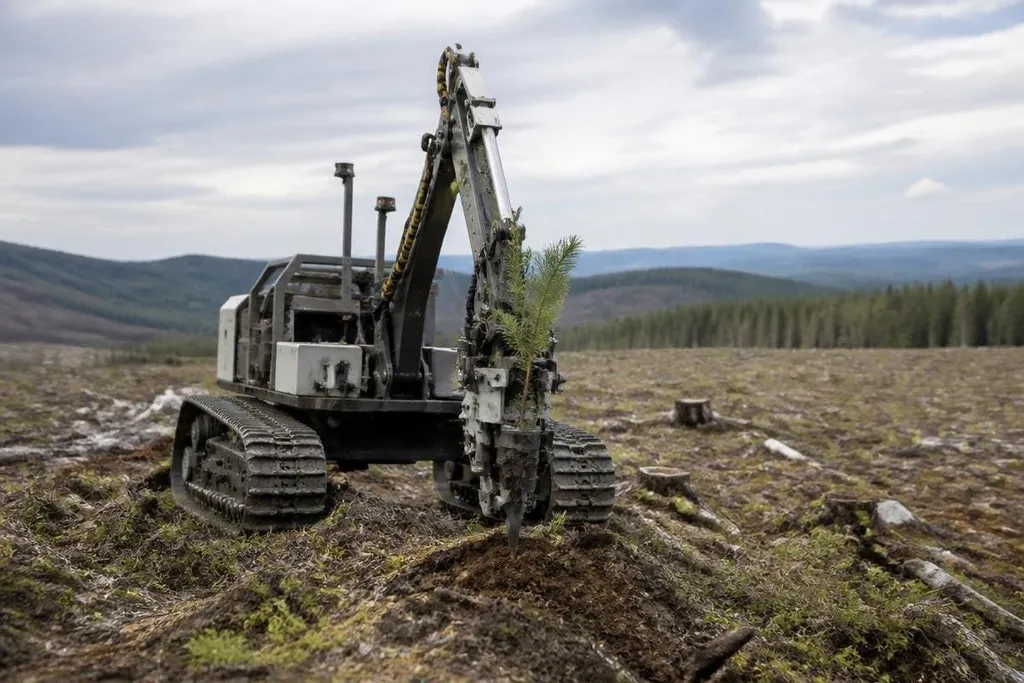
A tree-planting robot has to find a safe planting spot, place a seedling at the right depth, and leave the root ball intact. That sounds like a fixed task until the ground changes every few metres.
For anyone assessing automation in forestry, the question is practical: can a robot work across rough land for long enough to justify its cost?
Quick read
- Tree planting needs more than movement. The robot must read soil, slope, roots, and obstacles.
- A small autonomous vehicle may work in prepared rows, while mixed woodland needs more sensing and human checks.
- The open issue is field proof: planting speed, survival rate, repair time, and cost per healthy tree.
Where robots can help
A planting system could carry seedlings, make a hole, place each tree, and press soil around the roots. A camera or LiDAR sensor could help map trunks, rocks, stumps, and fallen branches before the robot moves.
That map matters because tree spacing affects later work. A robot that plants too close to a rock may lose a seedling at once. A robot that follows a fixed line without checking the ground can damage roots or stop when its wheels lose traction.
The machine also needs a way to handle seedlings. A gripper must hold the stem or root plug without crushing it. The planting tool must reach a repeatable depth, even when the soil is dry, loose, wet, or packed with roots.
These jobs point to a mixed system rather than a machine left alone for an entire site. Autonomy can guide movement and repeat simple planting steps, while a person checks faults, loads seedlings, and deals with ground the sensors cannot read well.
The land is the hard part
A farm field with prepared rows gives a robot clear paths. A forest restoration site may contain steep slopes, mud, brush, buried wood, and uneven ground in the same work area.
That changes the vehicle design. Tracks can spread weight across soft soil, but they may turn slowly and collect mud. Wheels can move efficiently on firm ground, yet lose grip on slopes. A low body can pass below branches, while a taller body may carry more seedlings and planting gear.
Positioning creates another problem. Global navigation satellite system signals can drift under trees, where leaves and trunks block part of the sky.
Cameras can help, and an inertial measurement unit can track motion, but each sensor has limits when dust, shade, rain, or vibration affects its data.
A planting robot also needs safe stopping behavior. If a person walks into its path, the machine must stop before the planting tool or vehicle reaches them. That requires sensors, control software, and a site plan that people can understand.
What proof should look like
A video of a robot placing one seedling shows the tool working. It doesn't show the cost of moving the robot, clearing jams, charging batteries, or returning to repair a damaged wheel.
Planting speed means little if the robot spends hours in transit or waiting for a repair. Reports on Robot 24 can tie a planting claim to the forest site, battery time, travel distance, and service work recorded during the trial. That record moves the test from one planted seedling to the number of seedlings that survive the first growing season.
The most useful tests would compare planted trees after the work is done. A fast planting run has little value if many seedlings sit too high, dry out, or lose contact with the soil. Survival after the first growing season may tell buyers more than the robot's top travel speed.
No evidence pack supports a claim that tree-planting robots have solved those problems today. That gap should stay visible. Makers can show a working prototype without proving long shifts, low repair needs, or lower cost than a trained crew.
A buying check for forestry teams
Before funding a pilot, ask for these details:
- Site limits: slope range, soil types, forest cover, and obstacle handling.
- Planting work: seedling types, hole depth, spacing accuracy, and root protection.
- Human work: loading time, supervision needs, fault recovery, and safe access.
- Machine figures: battery runtime, payload, ground clearance, turning method, and travel speed.
- Results after planting: survival checks, damaged seedlings, missed spots, and replanting work.
- Cost record: staff hours, transport, service parts, charging, and price per planted tree.
Those records would let a forestry manager compare a robot with the crew and tools already used on the site. They would also show where the machine earns its place: prepared land, difficult slopes, repeated rows, or work that people cannot safely reach.
I'd wait before buying a system whose maker shows only a short planting demo. The next useful proof is a full site record that links machine hours to healthy trees still growing after the first season.